
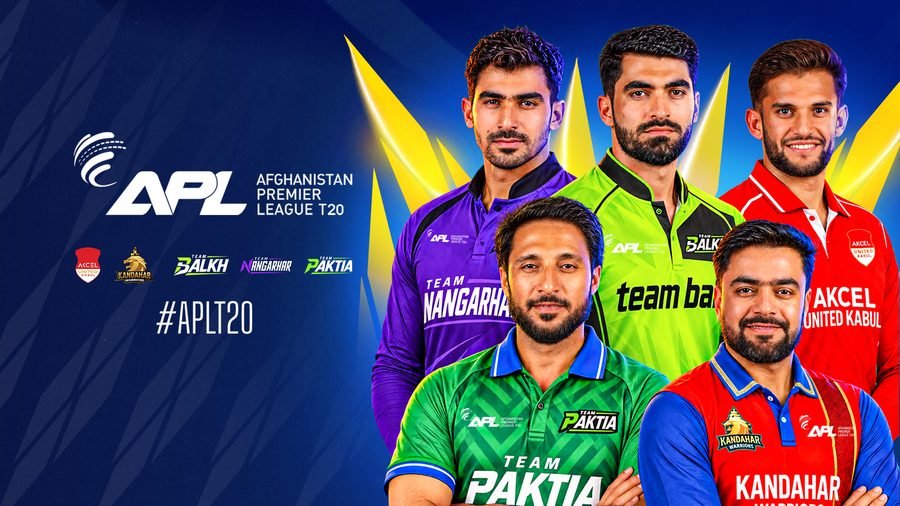
APL 2026 Captains: Rashid, Omarzai, Zadran & More
Rashid, Omarzai, Ibrahim, Rahmat Shah and Gurbaz arrive at the APL with different tools and one shared problem: no squad list yet.
Five teams, five captains, five mentors — the dugouts are set.

The Afghanistan Cricket Board has put the leadership of its relaunched Twenty20 league in place. On 2 November 2026, the board confirmed a captain, a head coach and a mentor for each of the five franchises, a day before the players' draft in Dubai and eight weeks before the first ball is bowled on 27 December. It is the clearest sign yet that the new Afghanistan Premier League is moving from announcements to cricket.
The Kandahar Warriors will be led by Rashid Khan, with Ravi Bopara as head coach and Irfan Pathan as mentor. It is a heavyweight combination: Afghanistan's biggest star as captain, a former England international guiding the side day to day, and one of India's most recognisable former all-rounders in the mentor's chair. Akcel United Kabul, meanwhile, have handed the captaincy to Azmatullah Omarzai, with Shane McDermott as head coach and Nikhil Chopra as mentor.
The other three franchises are just as striking. Rahmanullah Gurbaz captains the Nangarhar side, where Toby Radford is head coach and Mark Boucher fills the mentor role. Rahmat Shah leads the Paktia team, with Azhar Mahmood as head coach and Waqar Younis as mentor. And Ibrahim Zadran heads the Balkh side, which has Mickey Arthur as head coach and Tillakaratne Dilshan as mentor. Every dugout, in other words, has a name the crowd will know.
The line-ups were settled at a leaders' draft held during the week of 25 October, hosted by former Sri Lanka all-rounder Farveez Maharoof. Across two rounds, the five mentors picked their captains and their coaches, so each leadership group was built as a unit rather than assembled piece by piece. That process matters: a captain, a coach and a mentor who chose each other are more likely to agree on how a team should play than three people thrown together by a committee.
The mentor list is the headline. Pathan, Boucher, Waqar and Dilshan all played long international careers and have coached or mentored at the highest level since retiring, while Chopra brings his own long experience of Indian domestic cricket and broadcasting. Their job is not to pick the team or run training sessions; it is to steady young players, read match situations from the boundary, and pass on the kind of judgement that only comes from having been there before.
The head coaches bring a similar blend. Bopara, McDermott, Radford, Mahmood and Arthur have all worked inside franchise and international dressing rooms, and each of them now has a clear brief: turn a squad picked at auction into a team that can win seven matches in a month. With only five teams and a short season, there is little time to find form, so the first week of the tournament will test every one of these partnerships quickly.
The announcement set up the players' draft, held on 3 November in Dubai. Close to 1,500 Afghan and international players had registered, and the board pruned that pool to 462 names across the Platinum, Diamond, Gold, Silver and Emerging categories. Among the international names in the pool were Wanindu Hasaranga, Reeza Hendricks, Romario Shepherd, Rovman Powell, Imran Tahir, Shakib Al Hasan and Fakhar Zaman, alongside a large group of Afghanistan's own internationals.
The rules the franchises drafted under were strict. Each squad has 19 active players, with a core of 17 from the main draft and up to two more from a supplementary round. A minimum of 12 players must be Afghan or local, and each side can carry at most seven overseas players. Playing elevens must include between three and four overseas players and at least seven Afghan or local players, including at least one emerging player. At least one of the two Diamond-category players must be from Afghanistan, each franchise must pick at least one overseas player in the Platinum category and one in the Diamond category, and at least three overseas players must come within the first nine draft selections. The salary cap for player remuneration is US$725,000, and each franchise also holds one proposed wildcard pick.
The names carry weight because the league itself is starting over. The board first launched an Afghanistan Premier League in early 2018, and that edition featured high-profile names such as Chris Gayle, Brendon McCullum and Shahid Afridi. Only one season was played, between five teams, before the competition was discontinued following payment issues and concerns around its integrity. The 2026 edition is a fresh attempt, with new franchises, new leadership and a new home.
That home will not be Afghanistan itself. There is no official update on the venues, but it is understood that the first season of the relaunched league will be played in the United Arab Emirates, where the draft was also held. For a tournament trying to rebuild trust, a neutral, well-equipped base is a sensible choice, and the UAE's grounds are familiar to Afghanistan's players from years of home fixtures played there.
With the leadership groups confirmed and the draft done, the five squads are now set, and the focus turns to 27 December, when the season begins. The mentors will have seven weeks from the draft to shape their squads before the first match, and the captains will have the same window to settle combinations, batting orders and bowling plans. For a league returning after eight years away, the announcement of its captains, coaches and mentors was the moment it started to feel real.
Irfan Pathan mentors the Kandahar Warriors, Nikhil Chopra mentors Akcel United Kabul, Mark Boucher mentors the Nangarhar side, Waqar Younis mentors Paktia, and Tillakaratne Dilshan mentors Balkh. The Afghanistan Cricket Board confirmed all five mentor appointments on 2 November 2026, alongside the captains and head coaches for each franchise.
Rashid Khan captains the Kandahar Warriors, Azmatullah Omarzai leads Akcel United Kabul, Rahmanullah Gurbaz captains Nangarhar, Rahmat Shah leads Paktia, and Ibrahim Zadran captains Balkh. The captains were finalised at a leaders' draft held during the week of 25 October, hosted by former Sri Lanka all-rounder Farveez Maharoof.
Ravi Bopara coaches the Kandahar Warriors, Shane McDermott coaches Akcel United Kabul, Toby Radford coaches Nangarhar, Azhar Mahmood coaches Paktia, and Mickey Arthur coaches Balkh. Each head coach was picked alongside his captain and mentor at the leaders' draft, so every franchise's leadership group was built as a unit.
The season starts on 27 December 2026, and it will be played in the United Arab Emirates rather than in Afghanistan. The players' draft was held on 3 November in Dubai, with close to 1,500 registered players pruned to a pool of 462. Each franchise has a squad of 19 players and a salary cap of US$725,000.
Rashid, Omarzai, Ibrahim, Rahmat Shah and Gurbaz arrive at the APL with different tools and one shared problem: no squad list yet.
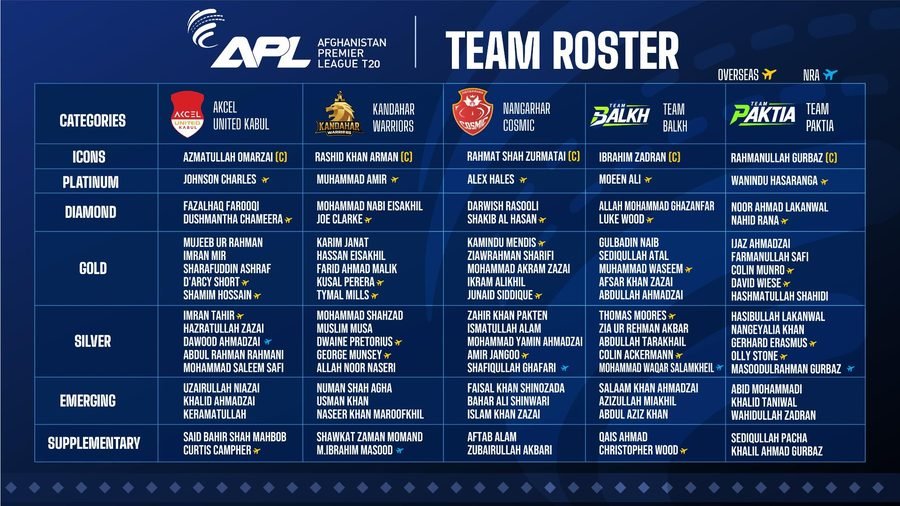
APL T20 2026 draft results from Dubai: 90 players from a pool of 462, Muhammad Amir the first pick, and every Platinum and Diamond selection, per the ACB.
APL 2026 squads team by team: captain, Platinum and Diamond picks, and the overseas players named for all five franchises in the ACB's 3 November release.